This Year 5 Speech Marks worksheet set focuses on converting speech bubbles into correctly punctuated direct speech, helping pupils apply accurate speech marks, commas, capital letters and end punctuation within extended dialogue.
The resource is fully differentiated across three levels (Triangles, Circles and Squares), allowing children to progress from supported sentence construction to more complex, multi-speaker dialogue.
Pupils practise turning comic-style speech bubbles into full speech sentences, ensuring correct punctuation and layout, including the key rule “new speaker, new line.” A range of reporting verbs is encouraged to develop more varied and engaging writing.
Each worksheet includes:
Clear, child-friendly instructions
Progressive tasks converting speech bubbles into direct speech
Opportunities to extend and continue dialogue
Full answer sheets with example answers
QR code access to a video explanation to support independent learning
This set is ideal for homework, classroom practice, revision or intervention, and aligns with UK Year 5 English curriculum expectations for punctuation and dialogue.
🔹 What’s Included
🔹 Differentiation Overview
Triangles (Lower ability)
Convert short speech bubbles into direct speech
Focus on correct speech marks and end punctuation
Clear structure and guided support
Circles (Expected level)
Turn multiple speech bubbles into full dialogue
Apply commas and reporting clauses accurately
Use “new speaker, new line” consistently
Squares (Higher ability)
Convert extended comic sequences into dialogue
Use varied reporting verbs
Write longer, more complex conversations
🔹 Learning Objectives
Children will:
Convert speech bubbles into correctly punctuated direct speech
Use speech marks accurately within sentences
Apply commas between speech and reporting clauses
Structure dialogue using new lines for new speakers
Use a range of reporting verbs appropriately
This Year 5 Speech Marks worksheet set focuses on converting speech bubbles into correctly punctuated direct speech, helping pupils apply accurate speech marks, commas, capital letters and end punctuation within extended dialogue.
The resource is fully differentiated across three levels (Triangles, Circles and Squares), allowing children to progress from supported sentence construction to more complex, multi-speaker dialogue.
Pupils practise turning comic-style speech bubbles into full speech sentences, ensuring correct punctuation and layout, including the key rule “new speaker, new line.” A range of reporting verbs is encouraged to develop more varied and engaging writing.
Each worksheet includes:
Clear, child-friendly instructions
Progressive tasks converting speech bubbles into direct speech
Opportunities to extend and continue dialogue
Full answer sheets with example answers
QR code access to a video explanation to support independent learning
This set is ideal for homework, classroom practice, revision or intervention, and aligns with UK Year 5 English curriculum expectations for punctuation and dialogue.
🔹 What’s Included
🔹 Differentiation Overview
Triangles (Lower ability)
Convert short speech bubbles into direct speech
Focus on correct speech marks and end punctuation
Clear structure and guided support
Circles (Expected level)
Turn multiple speech bubbles into full dialogue
Apply commas and reporting clauses accurately
Use “new speaker, new line” consistently
Squares (Higher ability)
Convert extended comic sequences into dialogue
Use varied reporting verbs
Write longer, more complex conversations
🔹 Learning Objectives
Children will:
Convert speech bubbles into correctly punctuated direct speech
Use speech marks accurately within sentences
Apply commas between speech and reporting clauses
Structure dialogue using new lines for new speakers
Use a range of reporting verbs appropriately

 Image 1 of 2
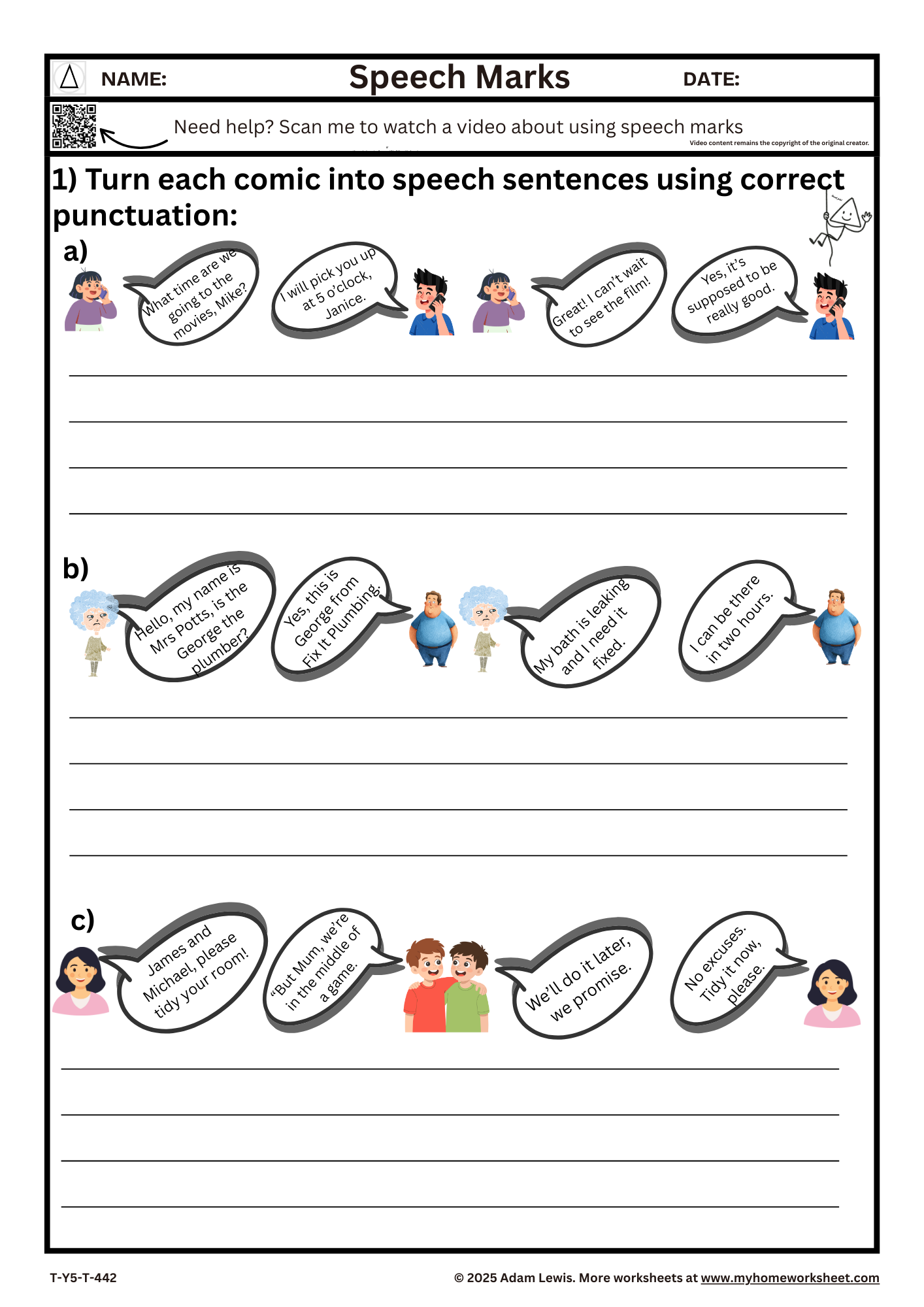 Image 2 of 2