
 Image 1 of 1
Year 5 Modal Verbs Worksheets (769-771)
Year 5 Modal Verbs Differentiated Worksheets with Answers – 3 Levels
📚 Build confidence with modal verbs through structured, differentiated grammar practice
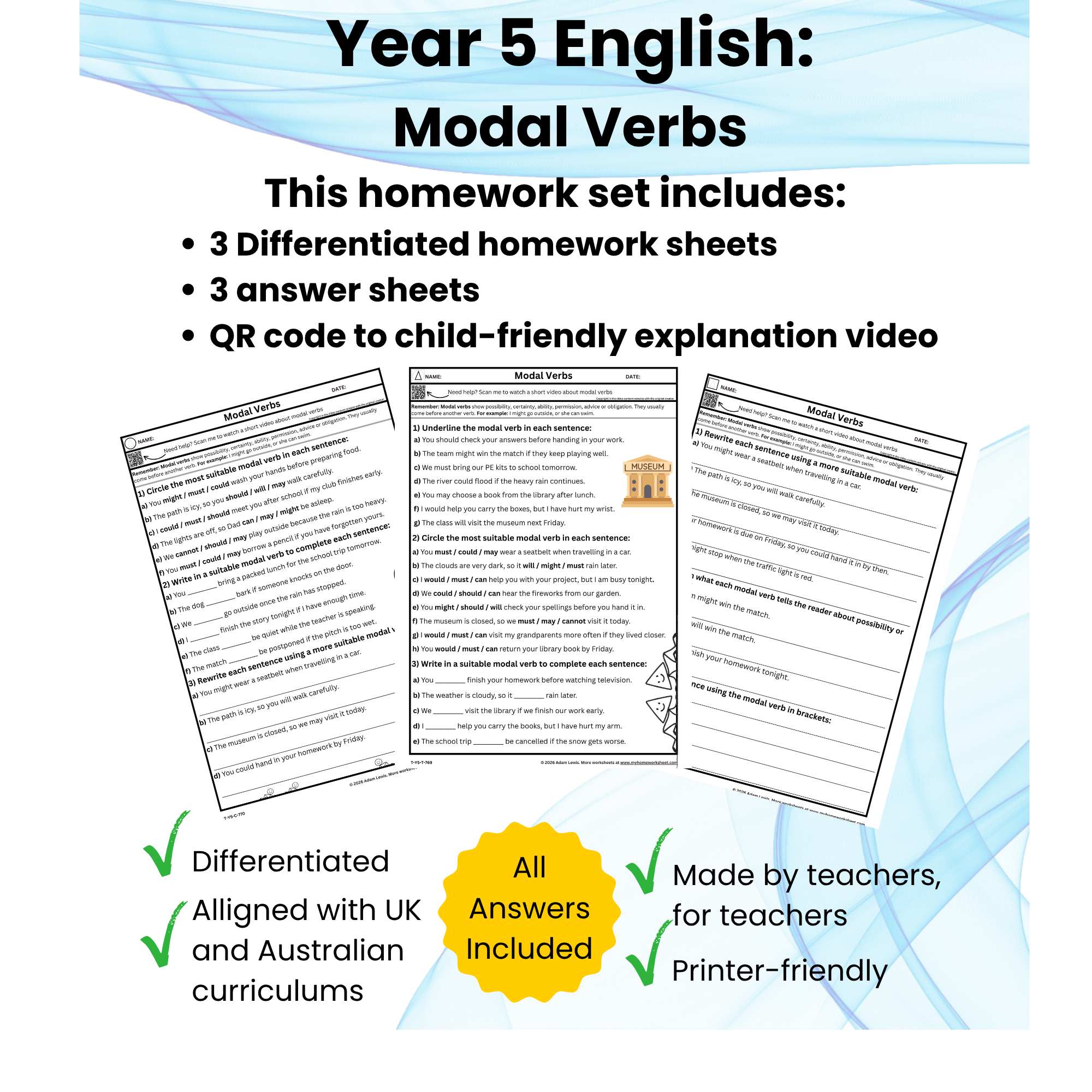
Help Year 5 pupils understand and use modal verbs with this carefully differentiated English grammar resource. The worksheets develop pupils’ ability to identify modal verbs, select suitable choices, complete sentences, correct inappropriate modal verbs and explain how modal verbs communicate possibility, certainty, ability, permission, advice and obligation.
The resource includes three clearly differentiated levels—Triangle, Circle and Square—allowing teachers, tutors, parents and home educators to select an appropriate level of support and challenge.
📄 What is included?
3 differentiated pupil worksheets
3 corresponding answer pages
6 A4 pages in total
48 individual questions and writing prompts
Triangle worksheet: lower-ability level
Circle worksheet: middle-ability level
Square worksheet: higher-ability level
QR code linking to a short external support video
Downloadable digital PDF
No physical item will be supplied
🔺 Triangle – Supported practice
The Triangle worksheet begins with identifying modal verbs in complete sentences. Pupils then select the most suitable modal verb from three choices before completing sentences with their own suitable modal verbs.
⭕ Circle – Developing understanding
The Circle worksheet moves pupils towards greater independence. Learners select suitable modal verbs, complete sentences without a choice bank and rewrite sentences using more appropriate modal verbs.
⬜ Square – Greater challenge
The Square worksheet requires pupils to rewrite sentences, explain what modal verbs tell the reader about possibility or certainty and construct original sentences using specified modal verbs.
✏️ Skills covered
Recognising modal verbs in sentences
Understanding possibility and certainty
Expressing ability and permission
Communicating advice and obligation
Selecting modal verbs according to meaning and context
Completing sentences appropriately
Rewriting sentences to improve meaning
Explaining the effect of modal verbs
Writing original sentences using modal verbs
Developing grammatical vocabulary and sentence control
🎯 Curriculum and assessment relevance
This resource supports common Year 5 grammar teaching involving modal verbs and degrees of possibility. It provides useful foundational practice for grammar and language-conventions work encountered in assessments such as UK SATs and Australia’s NAPLAN.
The resource is not officially endorsed by, affiliated with or aligned to SATs, NAPLAN or any particular national, state, provincial or regional curriculum.
🏫 Suggested uses
Whole-class English grammar lessons
Differentiated classroom practice
Independent seatwork
Homework
Revision and assessment preparation
Small-group intervention
Extension activities
Tutoring
Home education
Catch-up learning
🌍 Suitable for international learners
Although presented using Year 5 and UK English terminology, this resource may also be useful for teachers, parents, tutors, home educators and learners in Australia, the United States, Canada and other English-speaking countries.
It provides accessible primary and elementary English grammar practice without claiming formal alignment with any particular international curriculum.
🎥 Support video
Each page includes a QR code linking to a short external support video about modal verbs. Internet access is required to open the linked content. Copyright in the video remains with its original creator.
💻 Product details
Subject: English
Area: Grammar and punctuation
Topic: Modal verbs
Suggested level: Year 5 primary or comparable elementary grammar practice
Differentiation: Triangle, Circle and Square
File type: Digital PDF
Page size: A4
Total pages: 6
Pupil worksheets: 3
Answer pages: 3
Individual pupil questions or prompts: 48
Physical product: None
Year 5 Modal Verbs Differentiated Worksheets with Answers – 3 Levels
📚 Build confidence with modal verbs through structured, differentiated grammar practice
Help Year 5 pupils understand and use modal verbs with this carefully differentiated English grammar resource. The worksheets develop pupils’ ability to identify modal verbs, select suitable choices, complete sentences, correct inappropriate modal verbs and explain how modal verbs communicate possibility, certainty, ability, permission, advice and obligation.
The resource includes three clearly differentiated levels—Triangle, Circle and Square—allowing teachers, tutors, parents and home educators to select an appropriate level of support and challenge.
📄 What is included?
3 differentiated pupil worksheets
3 corresponding answer pages
6 A4 pages in total
48 individual questions and writing prompts
Triangle worksheet: lower-ability level
Circle worksheet: middle-ability level
Square worksheet: higher-ability level
QR code linking to a short external support video
Downloadable digital PDF
No physical item will be supplied
🔺 Triangle – Supported practice
The Triangle worksheet begins with identifying modal verbs in complete sentences. Pupils then select the most suitable modal verb from three choices before completing sentences with their own suitable modal verbs.
⭕ Circle – Developing understanding
The Circle worksheet moves pupils towards greater independence. Learners select suitable modal verbs, complete sentences without a choice bank and rewrite sentences using more appropriate modal verbs.
⬜ Square – Greater challenge
The Square worksheet requires pupils to rewrite sentences, explain what modal verbs tell the reader about possibility or certainty and construct original sentences using specified modal verbs.
✏️ Skills covered
Recognising modal verbs in sentences
Understanding possibility and certainty
Expressing ability and permission
Communicating advice and obligation
Selecting modal verbs according to meaning and context
Completing sentences appropriately
Rewriting sentences to improve meaning
Explaining the effect of modal verbs
Writing original sentences using modal verbs
Developing grammatical vocabulary and sentence control
🎯 Curriculum and assessment relevance
This resource supports common Year 5 grammar teaching involving modal verbs and degrees of possibility. It provides useful foundational practice for grammar and language-conventions work encountered in assessments such as UK SATs and Australia’s NAPLAN.
The resource is not officially endorsed by, affiliated with or aligned to SATs, NAPLAN or any particular national, state, provincial or regional curriculum.
🏫 Suggested uses
Whole-class English grammar lessons
Differentiated classroom practice
Independent seatwork
Homework
Revision and assessment preparation
Small-group intervention
Extension activities
Tutoring
Home education
Catch-up learning
🌍 Suitable for international learners
Although presented using Year 5 and UK English terminology, this resource may also be useful for teachers, parents, tutors, home educators and learners in Australia, the United States, Canada and other English-speaking countries.
It provides accessible primary and elementary English grammar practice without claiming formal alignment with any particular international curriculum.
🎥 Support video
Each page includes a QR code linking to a short external support video about modal verbs. Internet access is required to open the linked content. Copyright in the video remains with its original creator.
💻 Product details
Subject: English
Area: Grammar and punctuation
Topic: Modal verbs
Suggested level: Year 5 primary or comparable elementary grammar practice
Differentiation: Triangle, Circle and Square
File type: Digital PDF
Page size: A4
Total pages: 6
Pupil worksheets: 3
Answer pages: 3
Individual pupil questions or prompts: 48
Physical product: None