This Year 4 Suffixes: -ous worksheet set helps children understand how the suffix -ous is used to turn nouns into adjectives. Pupils practise spelling and using common -ous words, including dangerous, poisonous, famous, nervous, joyous, mountainous, adventurous, courageous, mysterious and furious.
The worksheets include a range of activities to support spelling, vocabulary development and sentence writing. Children are asked to add -ous to root words, complete sentences using the correct adjective, identify correct spellings, explain word meanings and write their own sentences using -ous words.
This resource is differentiated across three levels, making it suitable for mixed-ability Year 4 classes, homework, intervention groups and tutoring sessions.
What’s included?
This worksheet pack includes:
Triangle worksheet – a supported activity focusing on adding -ous, completing sentences and writing simple sentences using target words.
Circle worksheet – a middle-level activity including spelling practice, sentence completion, correct spelling choices and independent sentence writing.
Square worksheet – a more challenging activity requiring children to apply -ous words in context, explain meanings and create their own sentences.
Answer sheets are included for all three levels, making the resource quick and easy to mark.
Skills Covered
Adding the suffix -ous to root words
Understanding that -ous often changes nouns into adjectives
Recognising spelling changes before adding -ous
Using -ous adjectives in sentences
Choosing the correct spelling of common -ous words
Developing vocabulary and word meaning
Writing accurate sentences using spelling words
Improving KS2 spelling confidence
Example Words Included
dangerous
poisonous
famous
nervous
joyous
mountainous
adventurous
courageous
mysterious
furious
spacious
victorious
humorous
glorious
anxious
suspicious
cautious
tremendous
delicious
precious
various
enormous
Curriculum Links
This resource supports Year 4 English spelling objectives, particularly work on suffixes and word endings. It is useful for helping pupils understand how suffixes affect word class, meaning and spelling.
It is also helpful for wider spelling revision and vocabulary development across Lower Key Stage 2.
Suitable For
Year 4 English lessons
KS2 spelling practice
Suffixes and word endings work
Morning work
Homework
Literacy rotations
Intervention groups
Tutoring
Revision before assessments
SATs preparation
NAPLAN preparation
Home learning
Why Teachers and Parents Will Like It
This Year 4 -ous suffix worksheet pack is ready to print and easy to use. The differentiated levels allow children to work at an appropriate level while still practising the same spelling focus. The included answer sheets make marking simple, and the variety of tasks helps children move from spelling words correctly to using them confidently in context.
The worksheets are also suitable for international learners following a British-style curriculum or preparing for spelling, grammar and vocabulary assessments such as SATs and NAPLAN.
This Year 4 Suffixes: -ous worksheet set helps children understand how the suffix -ous is used to turn nouns into adjectives. Pupils practise spelling and using common -ous words, including dangerous, poisonous, famous, nervous, joyous, mountainous, adventurous, courageous, mysterious and furious.
The worksheets include a range of activities to support spelling, vocabulary development and sentence writing. Children are asked to add -ous to root words, complete sentences using the correct adjective, identify correct spellings, explain word meanings and write their own sentences using -ous words.
This resource is differentiated across three levels, making it suitable for mixed-ability Year 4 classes, homework, intervention groups and tutoring sessions.
What’s included?
This worksheet pack includes:
Triangle worksheet – a supported activity focusing on adding -ous, completing sentences and writing simple sentences using target words.
Circle worksheet – a middle-level activity including spelling practice, sentence completion, correct spelling choices and independent sentence writing.
Square worksheet – a more challenging activity requiring children to apply -ous words in context, explain meanings and create their own sentences.
Answer sheets are included for all three levels, making the resource quick and easy to mark.
Skills Covered
Adding the suffix -ous to root words
Understanding that -ous often changes nouns into adjectives
Recognising spelling changes before adding -ous
Using -ous adjectives in sentences
Choosing the correct spelling of common -ous words
Developing vocabulary and word meaning
Writing accurate sentences using spelling words
Improving KS2 spelling confidence
Example Words Included
dangerous
poisonous
famous
nervous
joyous
mountainous
adventurous
courageous
mysterious
furious
spacious
victorious
humorous
glorious
anxious
suspicious
cautious
tremendous
delicious
precious
various
enormous
Curriculum Links
This resource supports Year 4 English spelling objectives, particularly work on suffixes and word endings. It is useful for helping pupils understand how suffixes affect word class, meaning and spelling.
It is also helpful for wider spelling revision and vocabulary development across Lower Key Stage 2.
Suitable For
Year 4 English lessons
KS2 spelling practice
Suffixes and word endings work
Morning work
Homework
Literacy rotations
Intervention groups
Tutoring
Revision before assessments
SATs preparation
NAPLAN preparation
Home learning
Why Teachers and Parents Will Like It
This Year 4 -ous suffix worksheet pack is ready to print and easy to use. The differentiated levels allow children to work at an appropriate level while still practising the same spelling focus. The included answer sheets make marking simple, and the variety of tasks helps children move from spelling words correctly to using them confidently in context.
The worksheets are also suitable for international learners following a British-style curriculum or preparing for spelling, grammar and vocabulary assessments such as SATs and NAPLAN.

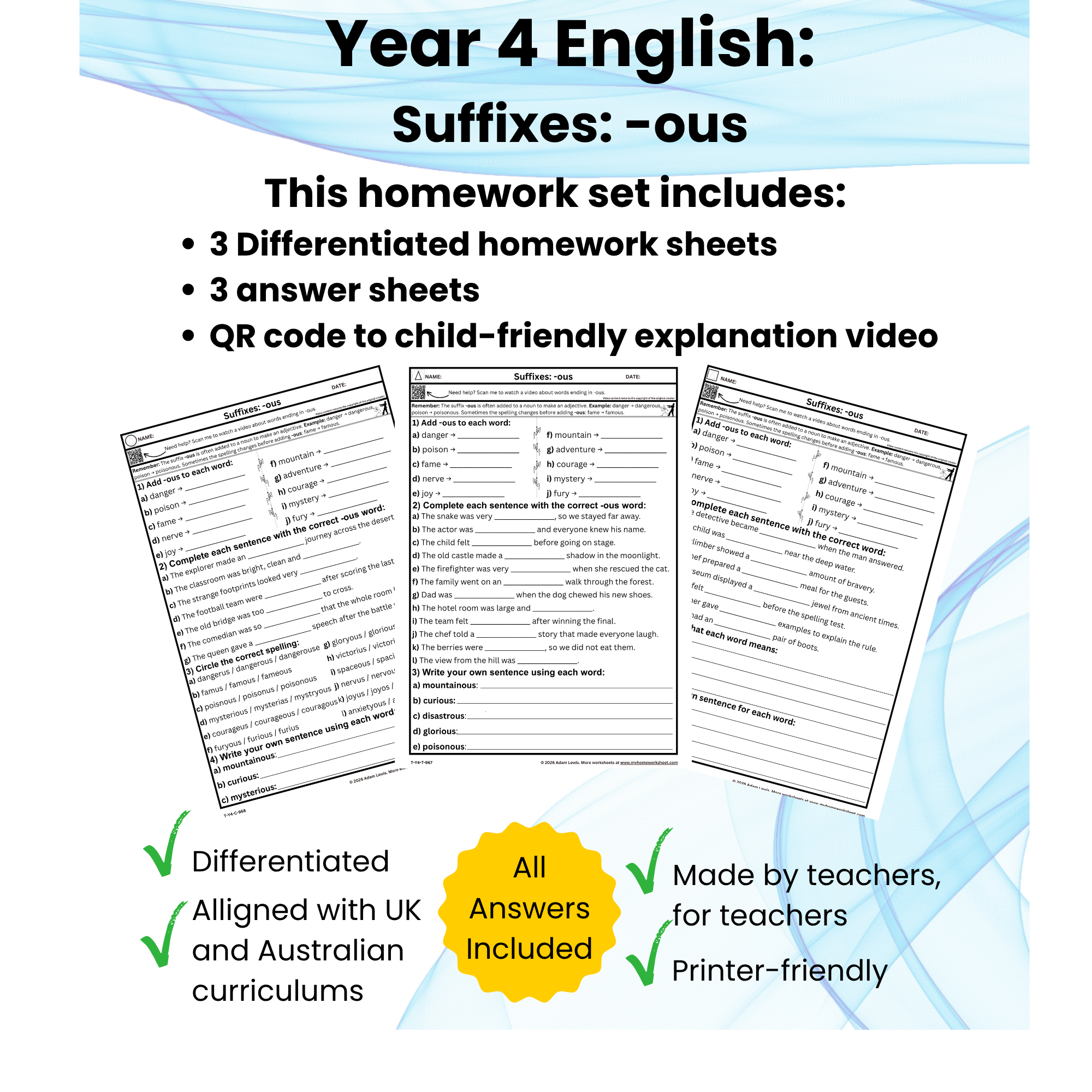 Image 1 of 1