
 Image 1 of 1
Year 4 Suffixes: -ly Worksheets (958-960)
Year 4 Suffix -ly Differentiated English Worksheets with Answers
✨ Build confidence with spelling, suffixes and adverbs
Help pupils understand how the suffix -ly is used to turn adjectives into adverbs with this engaging set of differentiated Year 4 English worksheets. The activities develop progressively from forming and using familiar -ly words to applying different spelling patterns and selecting correctly spelt adverbs.
Three clearly differentiated levels make it easy to choose an appropriate starting point for each learner.
📚 What is included?
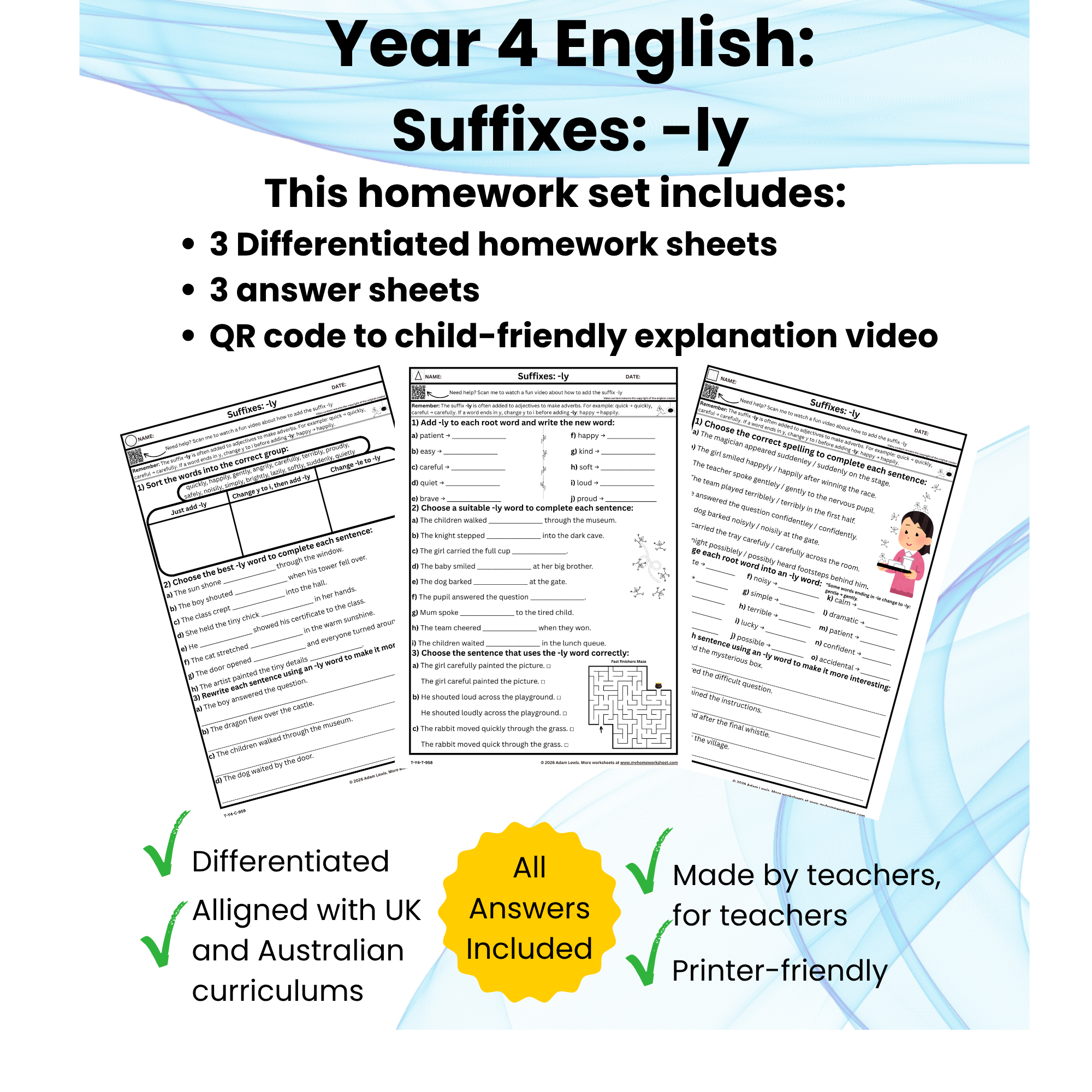
3 differentiated pupil worksheets
3 corresponding answer pages
6 A4 pages in total
Triangle, Circle and Square difficulty levels
A QR code linking to an external support video
A fast-finisher maze on the Triangle worksheet
Digital PDF format
No physical item will be supplied
🔺 Triangle – Developing confidence
Pupils begin by adding -ly to familiar root words, including patient, easy, careful, happy and proud. They then select suitable adverbs to complete sentences and identify sentences in which -ly words have been used correctly.
⚪ Circle – Applying spelling patterns
Learners sort words according to three spelling patterns:
Add -ly
Change y to i, then add -ly
Change -le to -ly
They also choose suitable adverbs in context and improve sentences by adding their own -ly words.
⬛ Square – Greater spelling challenge
The higher-level worksheet asks pupils to distinguish correct spellings from plausible incorrect alternatives. Learners then form adverbs from a wider selection of words, including fortunate, noisy, simple, terrible, dramatic, confident and accidental, before rewriting sentences using suitable adverbs.
📝 Skills covered
Understanding the suffix -ly
Forming adverbs from adjectives
Changing y to i before adding -ly
Changing words ending in -le to -ly
Recognising correctly and incorrectly spelt adverbs
Selecting vocabulary that suits the meaning of a sentence
Improving sentences with more precise description
Applying spelling and grammar knowledge independently
🎯 Curriculum and assessment relevance
The resource supports spelling, vocabulary, grammar and sentence-writing skills commonly developed in Year 4 and Key Stage 2 English. These foundational language skills can also support preparation for grammar, punctuation and spelling work associated with SATs, as well as spelling and language-conventions practice relevant to NAPLAN.
This resource is not officially endorsed by, affiliated with or claimed to be aligned with SATs, NAPLAN or any particular national, state or regional curriculum.
🏫 Suggested uses
Whole-class English lessons
Differentiated classroom practice
Weekly homework
Spelling revision
Grammar activities
Morning work
Intervention groups
Extension work
Tutoring
Home education
Independent learning
🌍 Suitable for international learners
Although presented using UK English spelling and Year 4 terminology, the worksheets may also be useful for teachers, parents, tutors, home educators and elementary learners in Australia, the United States, Canada and other English-speaking countries.
The activities focus on widely taught English spelling and grammar concepts, making them useful for primary maths—correction: primary English and elementary language arts settings internationally—without claiming alignment with any particular overseas curriculum.
📹 External video notice
The worksheets include a QR code linking to an external support video. The video is not created or owned by the worksheet author, and copyright remains with its original creator. Internet access is required, and the continued availability of the video is controlled by the hosting service and original creator.
📦 Product details
Subject: English
Focus: Suffix -ly, adverbs and spelling
Suggested level: Year 4 and comparable primary or elementary learners
Differentiation: Triangle, Circle and Square
Pupil worksheets: 3
Answer pages: 3
Total pages: 6
Page size: A4
Format: Digital PDF
Physical product: None
Year 4 Suffix -ly Differentiated English Worksheets with Answers
✨ Build confidence with spelling, suffixes and adverbs
Help pupils understand how the suffix -ly is used to turn adjectives into adverbs with this engaging set of differentiated Year 4 English worksheets. The activities develop progressively from forming and using familiar -ly words to applying different spelling patterns and selecting correctly spelt adverbs.
Three clearly differentiated levels make it easy to choose an appropriate starting point for each learner.
📚 What is included?
3 differentiated pupil worksheets
3 corresponding answer pages
6 A4 pages in total
Triangle, Circle and Square difficulty levels
A QR code linking to an external support video
A fast-finisher maze on the Triangle worksheet
Digital PDF format
No physical item will be supplied
🔺 Triangle – Developing confidence
Pupils begin by adding -ly to familiar root words, including patient, easy, careful, happy and proud. They then select suitable adverbs to complete sentences and identify sentences in which -ly words have been used correctly.
⚪ Circle – Applying spelling patterns
Learners sort words according to three spelling patterns:
Add -ly
Change y to i, then add -ly
Change -le to -ly
They also choose suitable adverbs in context and improve sentences by adding their own -ly words.
⬛ Square – Greater spelling challenge
The higher-level worksheet asks pupils to distinguish correct spellings from plausible incorrect alternatives. Learners then form adverbs from a wider selection of words, including fortunate, noisy, simple, terrible, dramatic, confident and accidental, before rewriting sentences using suitable adverbs.
📝 Skills covered
Understanding the suffix -ly
Forming adverbs from adjectives
Changing y to i before adding -ly
Changing words ending in -le to -ly
Recognising correctly and incorrectly spelt adverbs
Selecting vocabulary that suits the meaning of a sentence
Improving sentences with more precise description
Applying spelling and grammar knowledge independently
🎯 Curriculum and assessment relevance
The resource supports spelling, vocabulary, grammar and sentence-writing skills commonly developed in Year 4 and Key Stage 2 English. These foundational language skills can also support preparation for grammar, punctuation and spelling work associated with SATs, as well as spelling and language-conventions practice relevant to NAPLAN.
This resource is not officially endorsed by, affiliated with or claimed to be aligned with SATs, NAPLAN or any particular national, state or regional curriculum.
🏫 Suggested uses
Whole-class English lessons
Differentiated classroom practice
Weekly homework
Spelling revision
Grammar activities
Morning work
Intervention groups
Extension work
Tutoring
Home education
Independent learning
🌍 Suitable for international learners
Although presented using UK English spelling and Year 4 terminology, the worksheets may also be useful for teachers, parents, tutors, home educators and elementary learners in Australia, the United States, Canada and other English-speaking countries.
The activities focus on widely taught English spelling and grammar concepts, making them useful for primary maths—correction: primary English and elementary language arts settings internationally—without claiming alignment with any particular overseas curriculum.
📹 External video notice
The worksheets include a QR code linking to an external support video. The video is not created or owned by the worksheet author, and copyright remains with its original creator. Internet access is required, and the continued availability of the video is controlled by the hosting service and original creator.
📦 Product details
Subject: English
Focus: Suffix -ly, adverbs and spelling
Suggested level: Year 4 and comparable primary or elementary learners
Differentiation: Triangle, Circle and Square
Pupil worksheets: 3
Answer pages: 3
Total pages: 6
Page size: A4
Format: Digital PDF
Physical product: None