
 Image 1 of 1
Year 3 Suffix -ly Worksheets (934-936)
This Year 3 Suffix -ly Worksheets set helps pupils build confidence with spelling words ending in -ly and understanding how these words are often used as adverbs. The activities support children as they recognise the suffix -ly, add it to root words, apply common spelling rules, and use -ly words correctly in sentences.
The worksheets are differentiated across three levels, making them ideal for classroom teaching, homework, revision, intervention groups or independent practice. Pupils begin by identifying the suffix in words such as quickly, slowly, softly, bravely, happily and angrily, before moving on to spelling changes such as changing y to i before adding -ly. The higher-level tasks also include words ending in -le, such as gentle → gently, simple → simply and terrible → terribly.
This resource is particularly useful for developing pupils’ spelling accuracy, vocabulary, grammar awareness and sentence writing. It also supports wider preparation for spelling, grammar and punctuation expectations in KS2, including skills that are useful for later SATs work. For international schools or families following Australian curriculum links, the focus on suffixes, adverbs and sentence accuracy also provides helpful practice for NAPLAN-style spelling and grammar tasks.
Each worksheet includes clear instructions, child-friendly examples and structured practice. Answer sheets are included to make marking quick and easy for teachers, parents and tutors.
What’s Included
3 differentiated Year 3 worksheets:
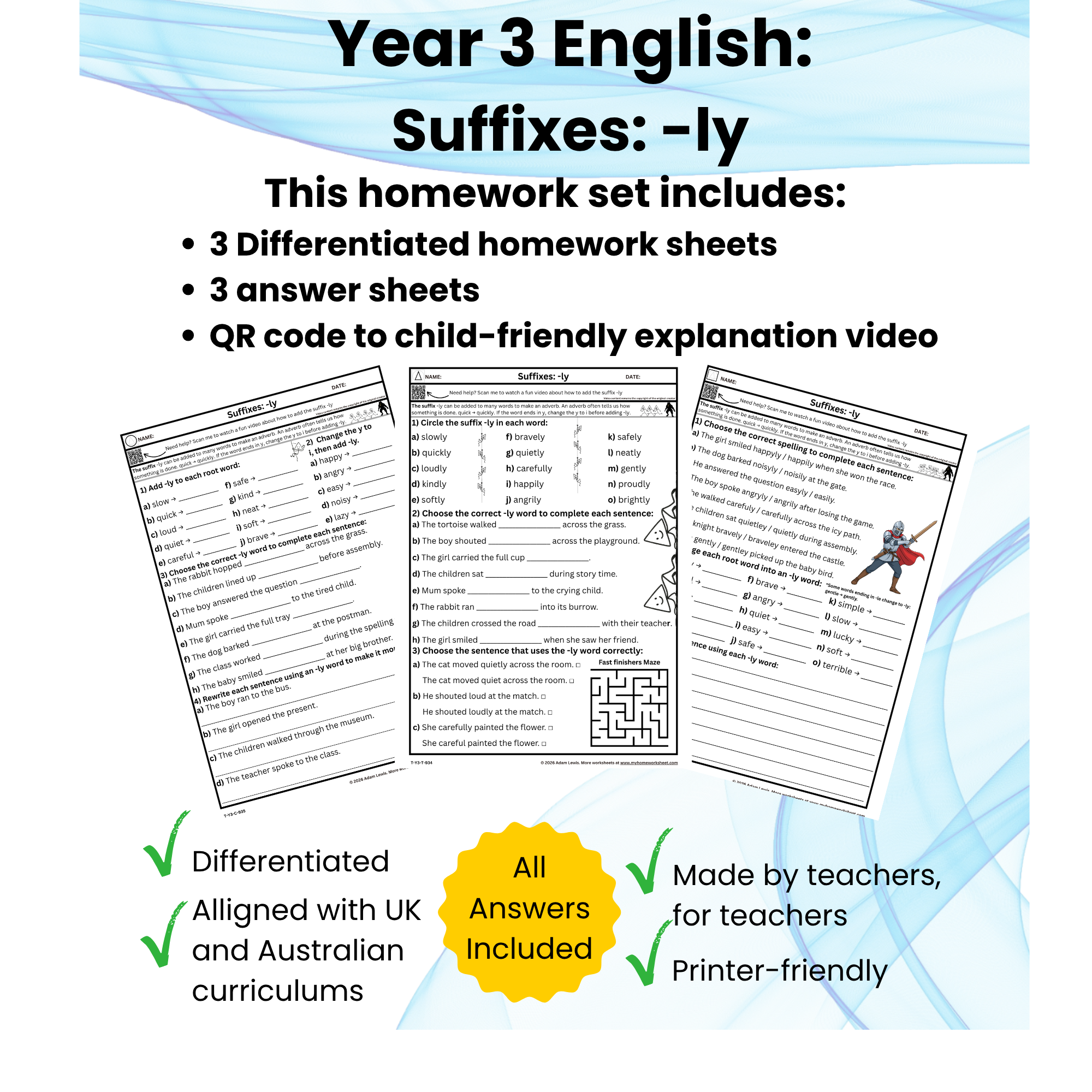
Triangles – Identify the suffix -ly, choose suitable -ly words to complete sentences, and select the sentence that uses an -ly word correctly.
Circles – Add -ly to root words, practise changing y to i before adding -ly, complete sentences with suitable -ly words, and rewrite sentences using adverbs.
Squares – Choose the correct spelling of -ly words, change root words into -ly words including more challenging spelling patterns, and write sentences using selected -ly adverbs.
3 answer sheets are also included.
Skills Covered
Adding the suffix -ly
Recognising -ly as a suffix
Understanding that many -ly words are adverbs
Using adverbs to describe how something is done
Changing y to i before adding -ly
Practising -le to -ly spelling changes
Choosing the correct spelling of -ly words
Completing sentences with suitable adverbs
Writing sentences using -ly words
Improving spelling, grammar and sentence accuracy
Example Words Included
slowly, quickly, loudly, kindly, softly, bravely, quietly, carefully, happily, angrily, safely, neatly, gently, proudly, brightly, easily, noisily, lazily, simply, luckily, terribly
Ideal For
Year 3 spelling lessons
KS2 English homework
Suffix and adverb practice
Grammar and punctuation revision
SATs preparation skills
NAPLAN-style spelling and grammar practice
Intervention groups
Tutoring sessions
Home learning
Morning work or independent tasks
Why Teachers and Parents Will Like This Resource
This worksheet set gives pupils repeated practice with the suffix -ly in a clear and manageable way. The tasks move from simple recognition to spelling rules and sentence writing, helping children understand both how -ly words are formed and how they are used. The differentiated structure makes it easy to match the work to different ability levels, while the included answer sheets save time when marking.
This Year 3 Suffix -ly Worksheets set helps pupils build confidence with spelling words ending in -ly and understanding how these words are often used as adverbs. The activities support children as they recognise the suffix -ly, add it to root words, apply common spelling rules, and use -ly words correctly in sentences.
The worksheets are differentiated across three levels, making them ideal for classroom teaching, homework, revision, intervention groups or independent practice. Pupils begin by identifying the suffix in words such as quickly, slowly, softly, bravely, happily and angrily, before moving on to spelling changes such as changing y to i before adding -ly. The higher-level tasks also include words ending in -le, such as gentle → gently, simple → simply and terrible → terribly.
This resource is particularly useful for developing pupils’ spelling accuracy, vocabulary, grammar awareness and sentence writing. It also supports wider preparation for spelling, grammar and punctuation expectations in KS2, including skills that are useful for later SATs work. For international schools or families following Australian curriculum links, the focus on suffixes, adverbs and sentence accuracy also provides helpful practice for NAPLAN-style spelling and grammar tasks.
Each worksheet includes clear instructions, child-friendly examples and structured practice. Answer sheets are included to make marking quick and easy for teachers, parents and tutors.
What’s Included
3 differentiated Year 3 worksheets:
Triangles – Identify the suffix -ly, choose suitable -ly words to complete sentences, and select the sentence that uses an -ly word correctly.
Circles – Add -ly to root words, practise changing y to i before adding -ly, complete sentences with suitable -ly words, and rewrite sentences using adverbs.
Squares – Choose the correct spelling of -ly words, change root words into -ly words including more challenging spelling patterns, and write sentences using selected -ly adverbs.
3 answer sheets are also included.
Skills Covered
Adding the suffix -ly
Recognising -ly as a suffix
Understanding that many -ly words are adverbs
Using adverbs to describe how something is done
Changing y to i before adding -ly
Practising -le to -ly spelling changes
Choosing the correct spelling of -ly words
Completing sentences with suitable adverbs
Writing sentences using -ly words
Improving spelling, grammar and sentence accuracy
Example Words Included
slowly, quickly, loudly, kindly, softly, bravely, quietly, carefully, happily, angrily, safely, neatly, gently, proudly, brightly, easily, noisily, lazily, simply, luckily, terribly
Ideal For
Year 3 spelling lessons
KS2 English homework
Suffix and adverb practice
Grammar and punctuation revision
SATs preparation skills
NAPLAN-style spelling and grammar practice
Intervention groups
Tutoring sessions
Home learning
Morning work or independent tasks
Why Teachers and Parents Will Like This Resource
This worksheet set gives pupils repeated practice with the suffix -ly in a clear and manageable way. The tasks move from simple recognition to spelling rules and sentence writing, helping children understand both how -ly words are formed and how they are used. The differentiated structure makes it easy to match the work to different ability levels, while the included answer sheets save time when marking.