
 Image 1 of 1
Year 3 Plurals Worksheets (949-951)
This Year 3 plurals worksheet set helps children practise forming plural nouns clearly and confidently. Pupils begin with regular plurals that simply need s, then move on to words that need es, words ending in y that change to ies, and common irregular plural nouns.
The activities are carefully differentiated across three levels, making them suitable for classwork, homework, intervention, revision or independent grammar practice.
What’s Included?
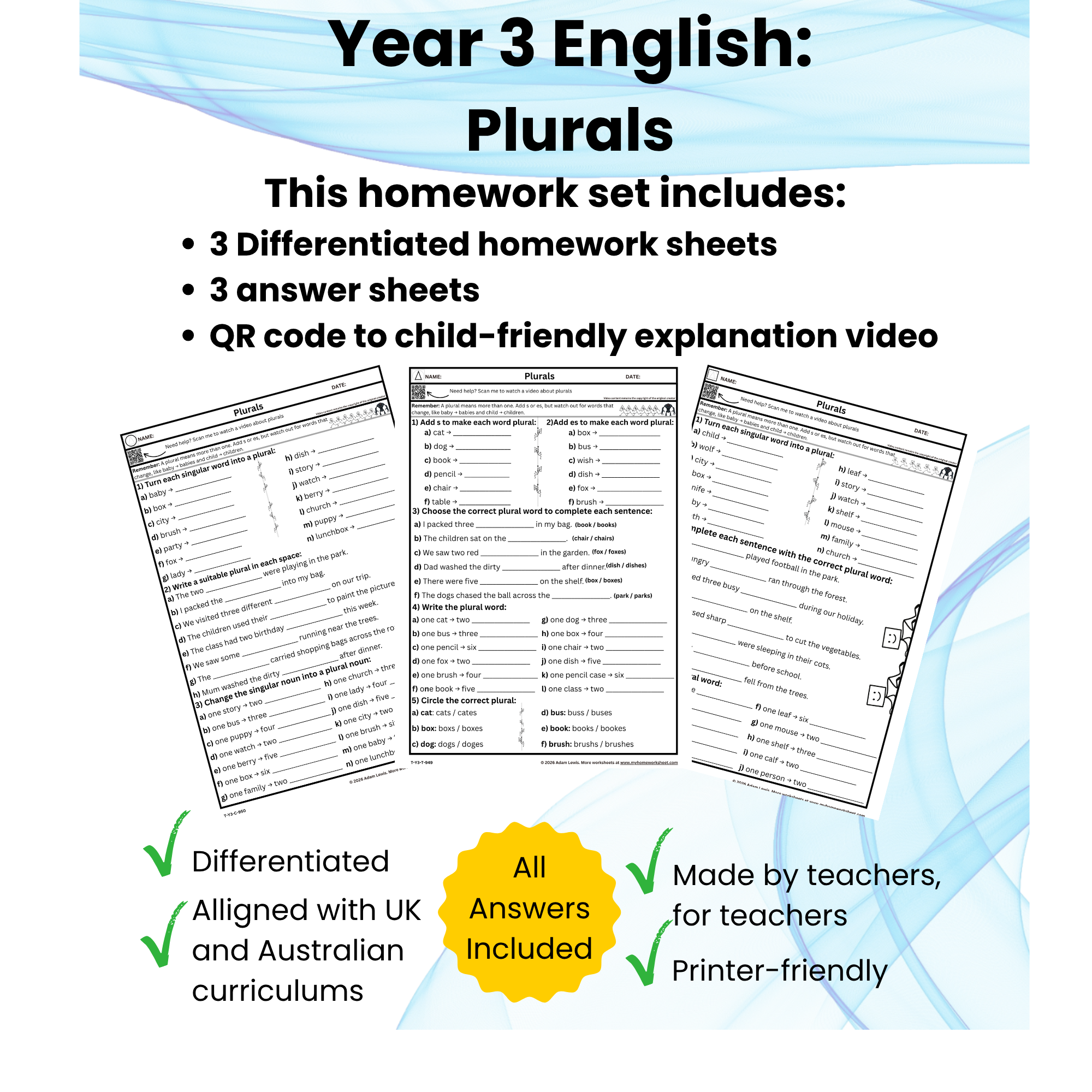
This resource includes three differentiated worksheets and matching answer sheets:
Triangles – Regular Plurals with s and es
Children practise simple plural nouns such as cats, dogs, books, pencils, boxes, buses, wishes, dishes, foxes and brushes. They complete words, choose correct plurals in sentences, write plural forms and circle the correct spelling.
Circles – y to ies and es Plurals
Children move on to words such as babies, cities, parties, ladies, stories, berries, puppies, churches and lunchboxes. They practise changing singular nouns into plural nouns and using suitable plurals in sentences.
Squares – Irregular Plurals and More Challenging Patterns
Children work with more advanced plural noun forms, including children, wolves, knives, teeth, leaves, shelves, mice, families, churches, calves and people. This gives pupils useful practice with irregular spelling patterns and less predictable plural forms.
Skills Covered
This worksheet set helps pupils practise:
Adding s to make simple plural nouns
Adding es to nouns ending in sounds such as x, s, sh, ch
Changing words ending in y to ies
Recognising and spelling irregular plurals
Using plural nouns correctly in sentences
Improving spelling accuracy and grammar confidence
Building understanding of singular and plural nouns
Why This Resource Is Useful
Plural spelling rules can be tricky for children because not all nouns follow the same pattern. This resource breaks the skill down step by step, allowing pupils to start with easier examples before moving on to more challenging words.
The differentiated layout means children can work at an appropriate level while still practising the same overall grammar focus. This makes the set useful for mixed-ability Year 3 classes, small-group support, homework or revision.
SATs and NAPLAN Relevance
Although this is a Year 3 resource, secure understanding of plural nouns supports later grammar and spelling success in KS2 SATs. Children need to recognise accurate spelling patterns, understand word classes and use nouns correctly in written sentences.
This resource is also useful for NAPLAN language conventions practice, especially for pupils who need to strengthen spelling, grammar and sentence accuracy. Plural noun rules, irregular spelling patterns and choosing the correct word form are all valuable skills for broader literacy development.
Perfect For
Year 3 spelling lessons
Year 3 grammar lessons
KS2 English homework
Plural noun revision
Morning work
Intervention groups
Independent practice
SATs preparation foundations
NAPLAN language conventions practice
EAL support
Printable literacy centres
Teacher Notes
Children may need reminding that:
A plural means more than one.
Most nouns just add s.
Some nouns add es, especially after s, x, sh, ch sounds.
Some words ending in consonant + y change to ies.
Some plurals are irregular and need to be learnt, such as child → children, tooth → teeth and mouse → mice.
Answer Sheets Included
All worksheets come with matching answer sheets, making the resource quick and easy to use for teachers, tutors and parents. The answers are clearly shown, allowing for fast marking, self-checking or guided review.
This Year 3 plurals worksheet set helps children practise forming plural nouns clearly and confidently. Pupils begin with regular plurals that simply need s, then move on to words that need es, words ending in y that change to ies, and common irregular plural nouns.
The activities are carefully differentiated across three levels, making them suitable for classwork, homework, intervention, revision or independent grammar practice.
What’s Included?
This resource includes three differentiated worksheets and matching answer sheets:
Triangles – Regular Plurals with s and es
Children practise simple plural nouns such as cats, dogs, books, pencils, boxes, buses, wishes, dishes, foxes and brushes. They complete words, choose correct plurals in sentences, write plural forms and circle the correct spelling.
Circles – y to ies and es Plurals
Children move on to words such as babies, cities, parties, ladies, stories, berries, puppies, churches and lunchboxes. They practise changing singular nouns into plural nouns and using suitable plurals in sentences.
Squares – Irregular Plurals and More Challenging Patterns
Children work with more advanced plural noun forms, including children, wolves, knives, teeth, leaves, shelves, mice, families, churches, calves and people. This gives pupils useful practice with irregular spelling patterns and less predictable plural forms.
Skills Covered
This worksheet set helps pupils practise:
Adding s to make simple plural nouns
Adding es to nouns ending in sounds such as x, s, sh, ch
Changing words ending in y to ies
Recognising and spelling irregular plurals
Using plural nouns correctly in sentences
Improving spelling accuracy and grammar confidence
Building understanding of singular and plural nouns
Why This Resource Is Useful
Plural spelling rules can be tricky for children because not all nouns follow the same pattern. This resource breaks the skill down step by step, allowing pupils to start with easier examples before moving on to more challenging words.
The differentiated layout means children can work at an appropriate level while still practising the same overall grammar focus. This makes the set useful for mixed-ability Year 3 classes, small-group support, homework or revision.
SATs and NAPLAN Relevance
Although this is a Year 3 resource, secure understanding of plural nouns supports later grammar and spelling success in KS2 SATs. Children need to recognise accurate spelling patterns, understand word classes and use nouns correctly in written sentences.
This resource is also useful for NAPLAN language conventions practice, especially for pupils who need to strengthen spelling, grammar and sentence accuracy. Plural noun rules, irregular spelling patterns and choosing the correct word form are all valuable skills for broader literacy development.
Perfect For
Year 3 spelling lessons
Year 3 grammar lessons
KS2 English homework
Plural noun revision
Morning work
Intervention groups
Independent practice
SATs preparation foundations
NAPLAN language conventions practice
EAL support
Printable literacy centres
Teacher Notes
Children may need reminding that:
A plural means more than one.
Most nouns just add s.
Some nouns add es, especially after s, x, sh, ch sounds.
Some words ending in consonant + y change to ies.
Some plurals are irregular and need to be learnt, such as child → children, tooth → teeth and mouse → mice.
Answer Sheets Included
All worksheets come with matching answer sheets, making the resource quick and easy to use for teachers, tutors and parents. The answers are clearly shown, allowing for fast marking, self-checking or guided review.