Help your Year 3 pupils understand how headings and subheadings are used to organise information with this differentiated English worksheet set.
This resource focuses on identifying, sorting and writing suitable headings and subheadings for a range of short non-fiction texts. Children practise matching subheadings to topics, choosing the best subheading for a paragraph, and organising information clearly using a main heading and supporting subheadings.
The worksheets are differentiated across three levels: Triangles, Circles and Squares, making them suitable for mixed-ability Year 3 classes, homework, revision, intervention or independent classroom practice.
The Triangles worksheet provides a supported introduction, asking children to sort given subheadings under the correct main headings, match sentences to subheadings and write simple subheadings for short paragraphs.
The Circles worksheet builds confidence by asking pupils to categorise subheadings, choose the best subheading for short paragraphs and create their own suitable subheadings.
The Squares worksheet gives pupils a greater challenge, requiring them to write their own subheadings and organise a longer rainforest text using one main heading and three appropriate subheadings.
This Year 3 English resource is ideal for developing reading comprehension, non-fiction writing, text organisation and grammar skills. It supports children in understanding how information texts are structured and helps them prepare for more confident independent writing.
What’s Included
3 differentiated Year 3 headings and subheadings worksheets
Triangles, Circles and Squares levels
Full answer sheets included
QR-linked video support
Clear non-fiction examples
Suitable for homework, classroom practice, revision or intervention
UK primary curriculum aligned
Useful for Australian curriculum practice and NAPLAN preparation
Help your Year 3 pupils understand how headings and subheadings are used to organise information with this differentiated English worksheet set.
This resource focuses on identifying, sorting and writing suitable headings and subheadings for a range of short non-fiction texts. Children practise matching subheadings to topics, choosing the best subheading for a paragraph, and organising information clearly using a main heading and supporting subheadings.
The worksheets are differentiated across three levels: Triangles, Circles and Squares, making them suitable for mixed-ability Year 3 classes, homework, revision, intervention or independent classroom practice.
The Triangles worksheet provides a supported introduction, asking children to sort given subheadings under the correct main headings, match sentences to subheadings and write simple subheadings for short paragraphs.
The Circles worksheet builds confidence by asking pupils to categorise subheadings, choose the best subheading for short paragraphs and create their own suitable subheadings.
The Squares worksheet gives pupils a greater challenge, requiring them to write their own subheadings and organise a longer rainforest text using one main heading and three appropriate subheadings.
This Year 3 English resource is ideal for developing reading comprehension, non-fiction writing, text organisation and grammar skills. It supports children in understanding how information texts are structured and helps them prepare for more confident independent writing.
What’s Included
3 differentiated Year 3 headings and subheadings worksheets
Triangles, Circles and Squares levels
Full answer sheets included
QR-linked video support
Clear non-fiction examples
Suitable for homework, classroom practice, revision or intervention
UK primary curriculum aligned
Useful for Australian curriculum practice and NAPLAN preparation

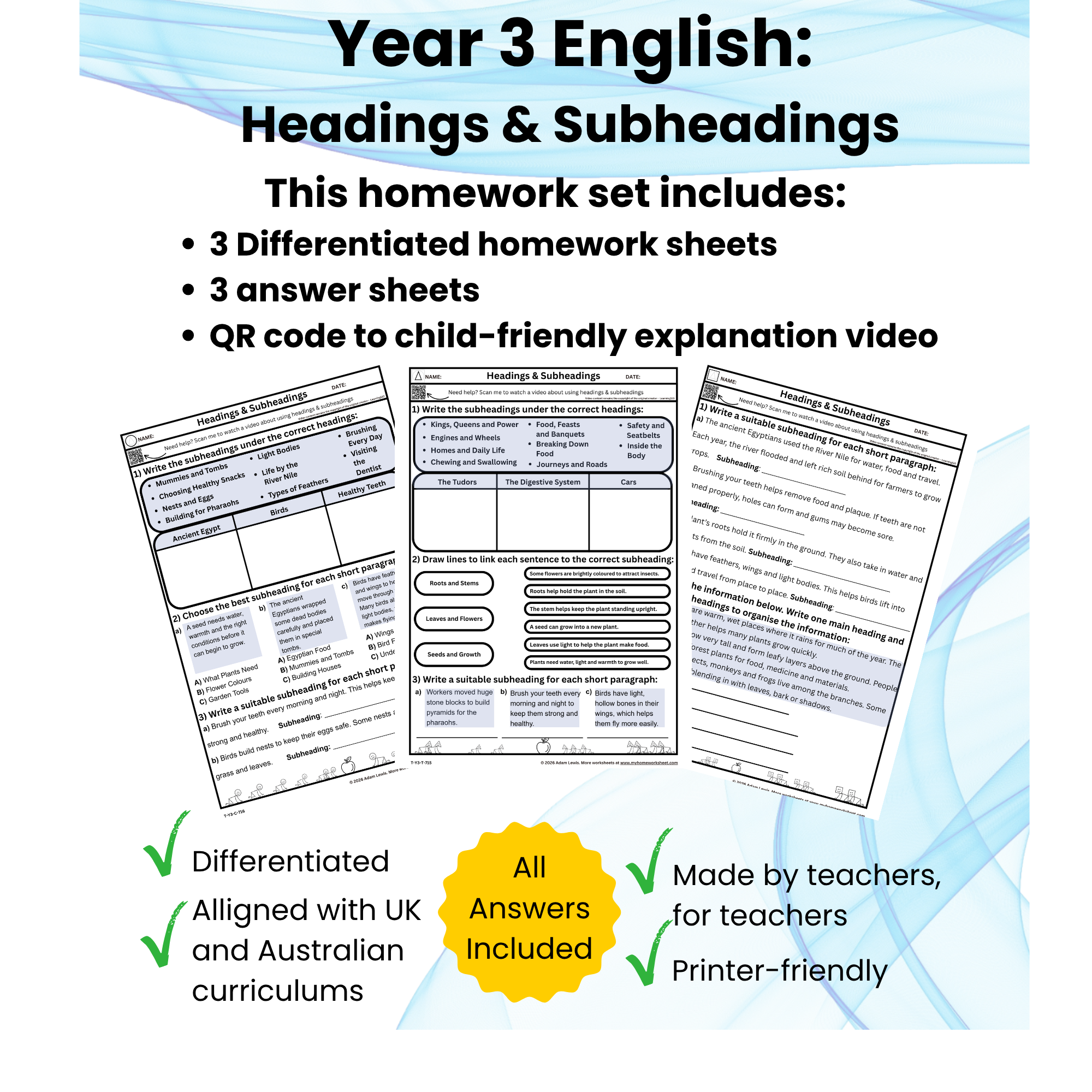 Image 1 of 1