This Year 3 fronted adverbials worksheet set helps children build confidence with an important grammar and punctuation skill. Pupils practise recognising fronted adverbials, placing commas correctly after them and using fronted adverbials to improve their own sentences.
The worksheets are differentiated across three levels, making them suitable for mixed-ability classes, homework, revision or independent grammar practice.
The activities include:
Triangles – support level
Children match simple fronted adverbials to suitable sentences, add commas after fronted adverbials and complete short sentences by adding their own fronted adverbials.
Circles – core level
Children add commas after fronted adverbials in full sentences, then write their own fronted adverbials to complete a range of sentence starters.
Squares – extension level
Children identify where commas are needed after fronted adverbials in a story paragraph, then add suitable fronted adverbials into a fantasy story opening before continuing the story independently.
This pack is useful for teaching pupils how fronted adverbials can show time, place, manner or sequence at the beginning of a sentence. It also supports children in understanding why commas are used after fronted adverbials.
Included in this pack:
3 differentiated worksheets
3 answer sheets
Support, core and extension levels
Commas after fronted adverbials practice
Sentence-level and paragraph-level activities
Creative writing extension task
Clear printable black-and-white layout
This resource is ideal for Year 3 grammar lessons, literacy rotations, morning work, homework, revision tasks or catch-up practice. It supports the UK National Curriculum focus on using fronted adverbials and is also useful for Australian Curriculum English practice, including grammar and punctuation revision for NAPLAN-style preparation.
What children will practise
Recognising fronted adverbials
Using commas after fronted adverbials
Completing sentences with suitable fronted adverbials
Improving sentence openers
Applying grammar skills in a paragraph
Writing with greater sentence variety
This Year 3 fronted adverbials worksheet set helps children build confidence with an important grammar and punctuation skill. Pupils practise recognising fronted adverbials, placing commas correctly after them and using fronted adverbials to improve their own sentences.
The worksheets are differentiated across three levels, making them suitable for mixed-ability classes, homework, revision or independent grammar practice.
The activities include:
Triangles – support level
Children match simple fronted adverbials to suitable sentences, add commas after fronted adverbials and complete short sentences by adding their own fronted adverbials.
Circles – core level
Children add commas after fronted adverbials in full sentences, then write their own fronted adverbials to complete a range of sentence starters.
Squares – extension level
Children identify where commas are needed after fronted adverbials in a story paragraph, then add suitable fronted adverbials into a fantasy story opening before continuing the story independently.
This pack is useful for teaching pupils how fronted adverbials can show time, place, manner or sequence at the beginning of a sentence. It also supports children in understanding why commas are used after fronted adverbials.
Included in this pack:
3 differentiated worksheets
3 answer sheets
Support, core and extension levels
Commas after fronted adverbials practice
Sentence-level and paragraph-level activities
Creative writing extension task
Clear printable black-and-white layout
This resource is ideal for Year 3 grammar lessons, literacy rotations, morning work, homework, revision tasks or catch-up practice. It supports the UK National Curriculum focus on using fronted adverbials and is also useful for Australian Curriculum English practice, including grammar and punctuation revision for NAPLAN-style preparation.
What children will practise
Recognising fronted adverbials
Using commas after fronted adverbials
Completing sentences with suitable fronted adverbials
Improving sentence openers
Applying grammar skills in a paragraph
Writing with greater sentence variety

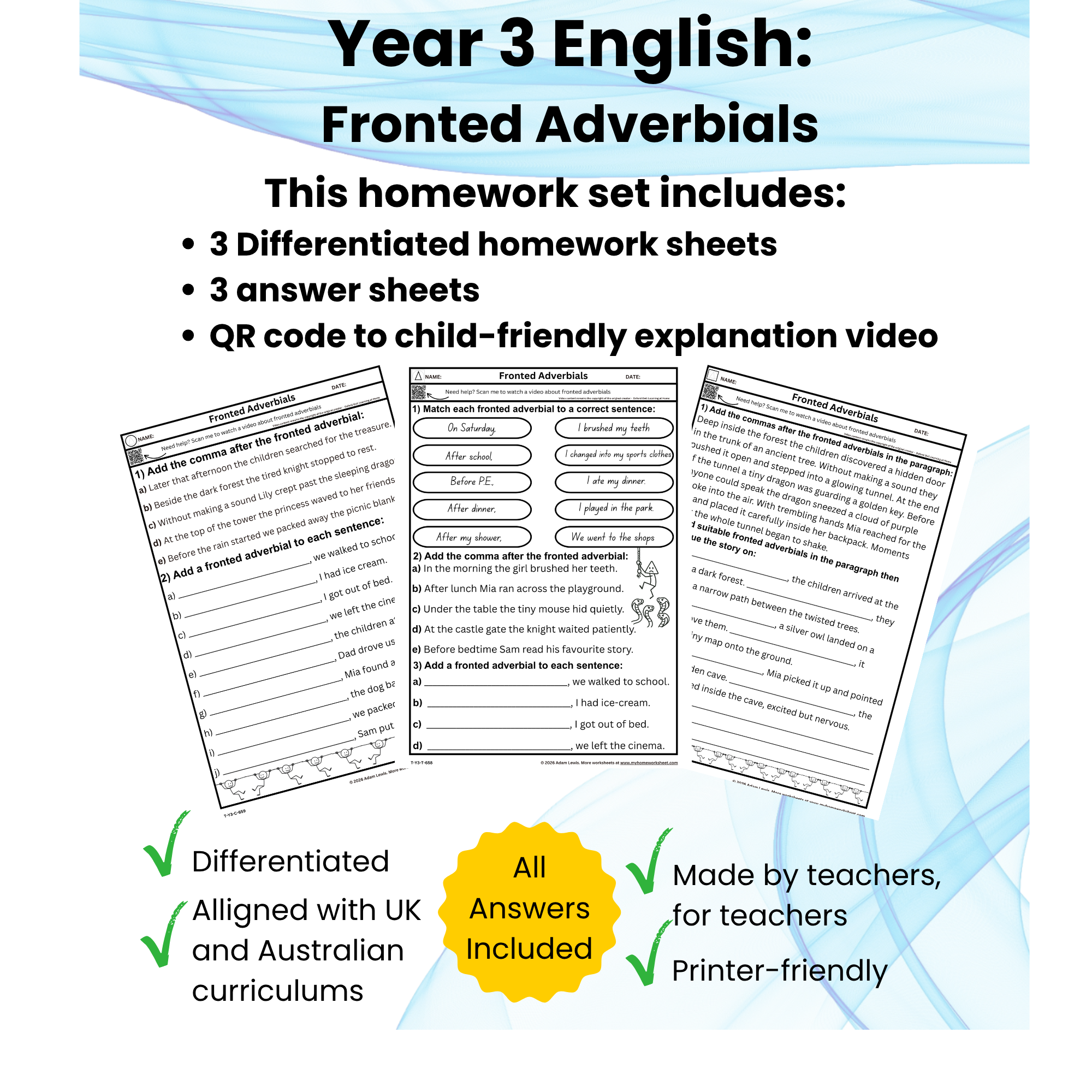 Image 1 of 1