
 Image 1 of 1
Year 3 Fronted Adverbials Worksheets (658-660)
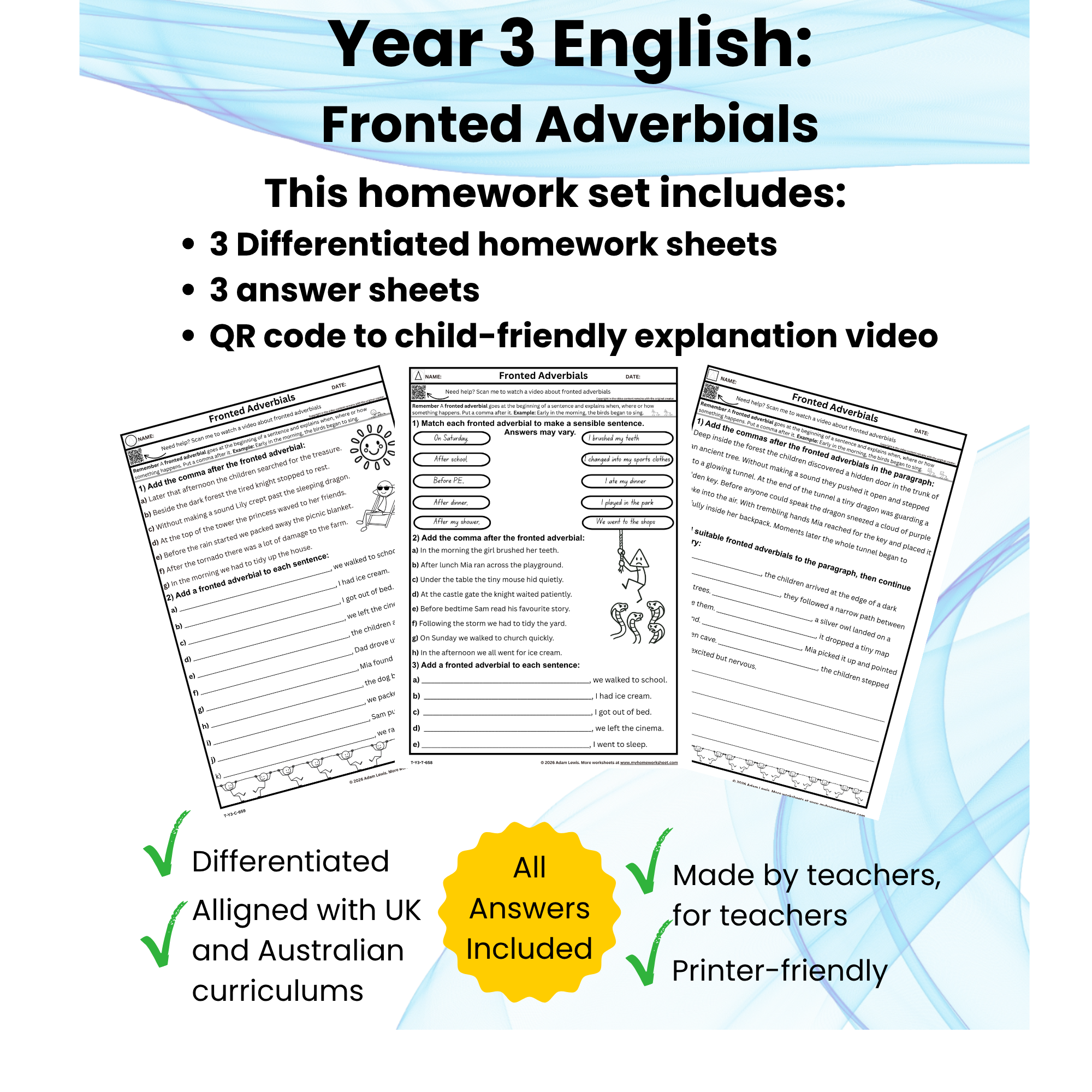
Year 3 Fronted Adverbials – 3 Differentiated Worksheets and Answers
✍️ Build confidence with fronted adverbials
Help pupils recognise, punctuate and use fronted adverbials with this differentiated Year 3 English resource. The activities progress from supported matching and sentence-level practice to paragraph editing and independent story writing.
This resource is suitable for primary classrooms, homework, intervention, tutoring, revision and home education.
📚 What is included?
3 differentiated pupil worksheets
3 corresponding answer pages
6 A4 pages in total
Triangle, Circle and Square difficulty levels
Matching, punctuation and sentence-completion activities
Paragraph editing and creative story continuation
Example answers for open-ended questions
A concise reminder explaining fronted adverbials
QR-code access to a support video about fronted adverbials
The video content belongs to its original creator. Internet access is required to use the QR-code video link, and continued availability depends on the external provider.
🔺 Triangle – supported level
The Triangle worksheet provides the greatest level of scaffolding. Pupils:
Match fronted adverbials to sensible sentence endings
Add missing commas to eight sentences
Add suitable fronted adverbials to five sentences
⭕ Circle – developing level
The Circle worksheet removes the matching support and gives pupils more independent sentence-level practice. Pupils:
Add missing commas to seven sentences
Create fronted adverbials for eleven different sentences
⬜ Square – greater challenge
The Square worksheet moves learning into connected writing. Pupils:
Add commas after six fronted adverbials in a paragraph
Add six suitable fronted adverbials to a story
Continue the story independently
🎯 Skills covered
Recognising fronted adverbials
Understanding how fronted adverbials explain when, where or how something happens
Using commas after fronted adverbials
Selecting suitable adverbial phrases
Improving sentence variety
Applying grammar knowledge in paragraphs
Developing creative and descriptive writing
🏫 Curriculum and assessment relevance
This resource supports the development of grammar, punctuation and sentence-construction skills used in primary English. It may help pupils practise foundational language skills relevant to SATs and NAPLAN-style grammar and punctuation work.
The resource is not officially endorsed by, affiliated with or aligned to SATs, NAPLAN or any particular national, state, provincial or regional curriculum.
🌍 Suitable for international learners
Although designed using familiar Year 3 and UK primary terminology, the activities may also be useful for teachers, parents, tutors, home educators and elementary learners in Australia, the United States, Canada and other English-speaking countries.
The term “fronted adverbial” is commonly used in UK education, while international teachers may also recognise related terms such as introductory adverbial phrase and sentence opener.
💡 Suggested uses
Whole-class grammar lessons
Differentiated classroom practice
Weekly homework
Morning work
Literacy stations
Grammar revision
Intervention and catch-up sessions
Extension work
Tutoring
Home education
SATs and NAPLAN foundational-skills practice
📄 Product details
Format: Digital PDF
Page size: A4
Total pages: 6
Pupil worksheets: 3
Answer pages: 3
Differentiated levels: Triangle, Circle and Square
Subject: English grammar and punctuation
Topic: Fronted adverbials
Suggested level: Year 3 primary and elementary learners
This is a downloadable digital resource. No physical item will be supplied.
Year 3 Fronted Adverbials – 3 Differentiated Worksheets and Answers
✍️ Build confidence with fronted adverbials
Help pupils recognise, punctuate and use fronted adverbials with this differentiated Year 3 English resource. The activities progress from supported matching and sentence-level practice to paragraph editing and independent story writing.
This resource is suitable for primary classrooms, homework, intervention, tutoring, revision and home education.
📚 What is included?
3 differentiated pupil worksheets
3 corresponding answer pages
6 A4 pages in total
Triangle, Circle and Square difficulty levels
Matching, punctuation and sentence-completion activities
Paragraph editing and creative story continuation
Example answers for open-ended questions
A concise reminder explaining fronted adverbials
QR-code access to a support video about fronted adverbials
The video content belongs to its original creator. Internet access is required to use the QR-code video link, and continued availability depends on the external provider.
🔺 Triangle – supported level
The Triangle worksheet provides the greatest level of scaffolding. Pupils:
Match fronted adverbials to sensible sentence endings
Add missing commas to eight sentences
Add suitable fronted adverbials to five sentences
⭕ Circle – developing level
The Circle worksheet removes the matching support and gives pupils more independent sentence-level practice. Pupils:
Add missing commas to seven sentences
Create fronted adverbials for eleven different sentences
⬜ Square – greater challenge
The Square worksheet moves learning into connected writing. Pupils:
Add commas after six fronted adverbials in a paragraph
Add six suitable fronted adverbials to a story
Continue the story independently
🎯 Skills covered
Recognising fronted adverbials
Understanding how fronted adverbials explain when, where or how something happens
Using commas after fronted adverbials
Selecting suitable adverbial phrases
Improving sentence variety
Applying grammar knowledge in paragraphs
Developing creative and descriptive writing
🏫 Curriculum and assessment relevance
This resource supports the development of grammar, punctuation and sentence-construction skills used in primary English. It may help pupils practise foundational language skills relevant to SATs and NAPLAN-style grammar and punctuation work.
The resource is not officially endorsed by, affiliated with or aligned to SATs, NAPLAN or any particular national, state, provincial or regional curriculum.
🌍 Suitable for international learners
Although designed using familiar Year 3 and UK primary terminology, the activities may also be useful for teachers, parents, tutors, home educators and elementary learners in Australia, the United States, Canada and other English-speaking countries.
The term “fronted adverbial” is commonly used in UK education, while international teachers may also recognise related terms such as introductory adverbial phrase and sentence opener.
💡 Suggested uses
Whole-class grammar lessons
Differentiated classroom practice
Weekly homework
Morning work
Literacy stations
Grammar revision
Intervention and catch-up sessions
Extension work
Tutoring
Home education
SATs and NAPLAN foundational-skills practice
📄 Product details
Format: Digital PDF
Page size: A4
Total pages: 6
Pupil worksheets: 3
Answer pages: 3
Differentiated levels: Triangle, Circle and Square
Subject: English grammar and punctuation
Topic: Fronted adverbials
Suggested level: Year 3 primary and elementary learners
This is a downloadable digital resource. No physical item will be supplied.